Thursday, June 5, 2014

Dairy Diary aka Shavuot in Israel

Two of the many advantages of living in Israel is that Shavuot is a one-day holiday and that for dairy lovers, there are a plethora of dairy products available.  Also an advantage, a copy of Dairy Made Easy, the new cookbook from Leah Schapira and Victoria Dwek arrived right before Shavuot.

Number One recipe for this reviewer and her "tasting committee:"  Israeli Pizza Dip.  It's bad enough that people put corn on their pizza here.  It's bad enough that the secret ingredient pizza spice is a combination of sugar and MSG (probably lethal in large quantities).  Then you have to dip your pizza.  Many stores give out packages of Thousand Island Dressing, but it is not the same.  These two talented cooks have captured the flavor and enhanced it with the right combination of spices, a little kick, and no added sugar.  I could not figure out why someone would want to add anything to an already delicious slice of pizza, but after tasting this dip, I can see why it is so popular.

Shavuot is also a great time for dairy baking with real butter, which tastes so much better than margarine.  We had a standard Israeli cheesecake, which disappeared; and a layered dessert, which will probably not be made again because it did not disappear.  On the list for next year's dairy baking:  Chocolate Cheese Muffins with Chocolate Ganache and Sour Cream Chocolate Chip Cake.

Leading up to Shavuot is the Counting of the Omer.  The period between Passover and Shavuot is an opportunity to get ready to receive the Torah.  For me, once I have cleaned out the chametz, not just the physical bread and pasta, but any spiritual chametz in terms of ego or patterns of behavior that are not working, it's time to keep the momentum going. The mere act of counting these days has a meditative and anticipatory quality, and although I do not look forward to the Omer in terms of no music or celebrations, I do look forward to some spiritual growth.

I found an interesting book to add to my collection of  "Omer" books (see the AJL Bibliography Bank for a list). Through the Gates:  A Practice for Counting the Omer by Susan Windle took me out of my comfort zone.  She is a poetess who is involved with the Jewish Renewal Movement, and her life and background are totally different than mine.  But I identified with the Omer has a sacred time and space to think about different aspects of relationships with God, with other people, and with myself.  I also identify with following the structure of the count (at night, with a blessing, mentioning both days and weeks), while finding a way to make it your own, either through poetry, chanting, or just quiet time.

Jeanette Walls says that "one benefit of summer is that each day we have more light to read by."  Some I'm looking forward to more light and more reading.  What about you?


Tuesday, May 20, 2014

Another Literary Day in Israel

I recently traveled to Jerusalem and enjoyed two book and writing-related meetings.  It was a little sad to have to return home early and miss the goings on at the Jerusalem International Writers' Festival, which took place May 18th through the 23rd, and was "a week of conversations between Israeli and guest authors, panel discussion and workshops, literature and film including events for children and a celebration of the poet Yehuda Amichai, all hosted by Mishkenot Sha’ananim."

My first stop was at Tmol Shilshom, a favorite cafe located in a courtyard near Jaffa Road.
The "bookstore-cafe-restaurant" takes its name from a novel by Nobel Prize winner S.Y. Agnon.  After a bracing cup of coffee,
it was time to work out at the Writing Gym.  Judy Labensohn served as trainer for this session, but she will be alternating with award-winning journalist Ilene Prusher in the weeks to come.  What is a Writing Gym?  It's where you give your imagination and your writing skills some exercise.  Judy provided three writing prompts, and the group considered each topic and wrote - either by hand or on a computer.  As someone who aspires to write, but never takes the time or gets sidetracked by the baskets of laundry, this was a welcome opportunity to get in the habit of writing something every day.  Some of the participants read their work, and it was really interesting to see how different people approached the topic.


From there I took the cross-town bus to Talpiot, where I met with Tzvi Maurer of Urim Publications.  This publisher is mostly known for excellent non-fiction and biography, but I heard about a new work of fiction.

The Mystery of the Milton Manuscript by Barry M. Libin.  It is "the story of Keith Jessup, a PhD student at Oxford, whose professor is murdered before delivering a lecture disclosing Milton’s own explanation of Paradise Lost. In his stead, Keith takes up the quest to find the Milton Manuscript and finally unravel the meaning of the epic poem. The scholarly hunt proves perilous as he discovers a plot to conceal the manuscript. Why? What could it contain that would spark such fear and murder over the centuries?"


After seeing some "Real Cats of Israel,"  I returned home to my baskets of laundry.


Happy reading!

Tuesday, May 13, 2014

The Jerusalem Writers' Seminar

I recently attended the Jerusalem Writers' Seminar, where I spent the day listening to some of my favorite authors and writers talk about their craft.  Obviously part of the fun of my day was going to Jerusalem.  The van driver took the scenic route from my town into the city, and the views of the hills and trees were amazing.  The seminar took place on Kanfei Nesharim street, which means "wings of eagles."  It was once used as a landing strip to fly supplies from Tel Aviv to Jerusalem, but now it is a vibrant thoroughfare, full of shops, restaurants and government offices.

Being an author groupie, I enjoyed meeting some of my favorite Jewish authors:

Yaffa Ganz, who was the recipient of a Sydney Taylor Book-of-Work Award, gave a workshop entitled "The Art of Writing What Publishers Hesitate to Print," and reminded writers that people will often be more receptive to your message if it is presented respectfully and with appropriate language.  Could you write an article about the beauty of the Israeli flag for an anti-Zionist publication?  Could you convince Orthodox readers that women should wear tefillin?  I have no doubt that Yaffa Ganz could, but for the rest of us it would be a challenge.

I got a peak at her latest book, All Kinds of Kids.  This collection of stories goes through the alphabet (Thankfully, no contrived use of the letter "X") with Eager Ezra, Helpful Hinda and more.  The short chapters make for easy reading, and, of course, it's Yaffa Ganz, author of Savta Simcha and so many other timeless Jewish children's books.


I also met one of the organizers of this lovely day, Tamar Ansh.  Tamar's most recent book, Let My Children Cook!, as an adorable, easy to use cookbook for kids. Besides Passover's "Very Important Recipes (VIRs)" like Charoses and Matzo Balls, you can use many of the gluten-free recipes all year round, and who doesn't love "Scribbled Eggs" or a banana milkshake?


Libi Astaire also attended the seminar and gave a workshop.  As a Regency Romance addict, I love the Ezra Melamed series, which strikes the right balance between Jewish content and the language and customs of the period.  The Disappearing Dowry was named a Sydney Taylor Notable Book, and "in this fourth volume of the series, The Doppelganger's Dance, David Salomon, a young violinist and composer, has left New York to find fame and fortune in Regency London. But disaster strikes not long after he arrives. Someone is stealing and publishing his compositions before he can perform them and soon he is the laughingstock of the beau monde that he had hoped to conquer. With few friends and even fewer resources, he turns to Ezra Melamed for help with finding the thief."


On the subject of the beauty of Israel, my friends at Go2Films are distributing a spectacular movie:  The Land of Genesis.


Here is a brief synopsis:

"The film presents the "Experience of The Land of Genesis" by following three mammals in their respective geographic habitats, as the seasons change. Each of the animals – the wolves of the Golan Heights, the swamp cats of the Sea Of Galilee and the ibexes of the desert – will open a window to the world of plants and animals of the region, a world filled with amazing beauty, a world in which there is no hatred, and which is guided only by one urge – the urge for survival.
Utilizing the amazing landscape shots by the international awards winning cinematographer Moshe Alpert, and the magnificent ethnic-inspired music of Uri Ophir and internationally-acclaimed singer Noa, we managed to create a unique film, an uplifting experience of sound and color."

Happy Reading!


Sunday, May 11, 2014

What If?

What if you were doing what you usually do on a normal day, and all of a sudden it starts raining?  But then it doesn't stop raining.  Sixteen-year-old Sebah is caught in what turns out to be "The Flood."  She ends up as a stowaway on Noah's Ark and is a witness to all that goes on.

There is no spoiler alert necessary because I'm not including any spoilers.  I am usually not a fan of books based on biblical stories that push creative license to the point of blasphemy or heresy.  But Ms. Napoli did her research in many areas (and I do love an obviously well-researched book).  The time frame stays true to the biblical time frame as to when the rain stopped, when the mountain tops could be seen, and when everyone finally got off the Ark.  The animal behavior, particularly some fun-loving primates, is also accurate, as are the descriptions of the foods and plants.  She even includes the midrash of Og, the King of Bashan, riding on top of the Ark.

While reading the book, many things came to mind.  In a way, STORM fits in the current trend of dystopic books - having the violent, evil world destroyed by a flood is pretty frightening, and the details of how Sebah deals with life on a daily basis, while retaining hope for the future, is what keeps the book moving at a steady pace.  It also brought back fond memories of APE HOUSE by Sara Gruen, another great book.  

While many children's book portray Noah happily feeding the pairs of animals, Napoli explored the interaction between the people on the Ark.  When you think about it, spending days cooped up in the rain makes people tense and irritable, especially when they spend those days feeding and cleaning up after animals.

For those who may worry, I checked all the biblical passages and calculated the days myself, and the book does not veer far from the original story.  I continue to assert that Noah was not Jewish, since Abraham was the first Jew (10 generations later).  So while the story of Noah is not a particularly Jewish story, it is a biblical one.  Napoli's tale is gritty and imaginative. To quote the author:  "people who are religious can open it without fear of having what they hold dear being trampled.  New perspectives can sometimes support old ones in an enriching way, rather than supplant or denigrate them."

STORM poses that challenging question to the reader.  What if?  What if you were on the Ark?  How would it smell? (Probably pretty bad).  What would you eat?  How would you pass what little free time you had?  How would you feel before, during, and after the rain? Were there rainbows before God "set his rainbow in the cloud" and promised "the water shall never again become a flood to destroy all flesh." (Genesis 9, verses 13-15).  Do you think the world today would qualify to be flooded?

The book is appropriate for both young adults and adults.  Young adults will identify with the 16-year-old Sebah, who deals with a combination of dystopia, Big Brother and Survivor.  Adults will appreciate how closely STORM follows the biblical account.


Sunday, February 23, 2014

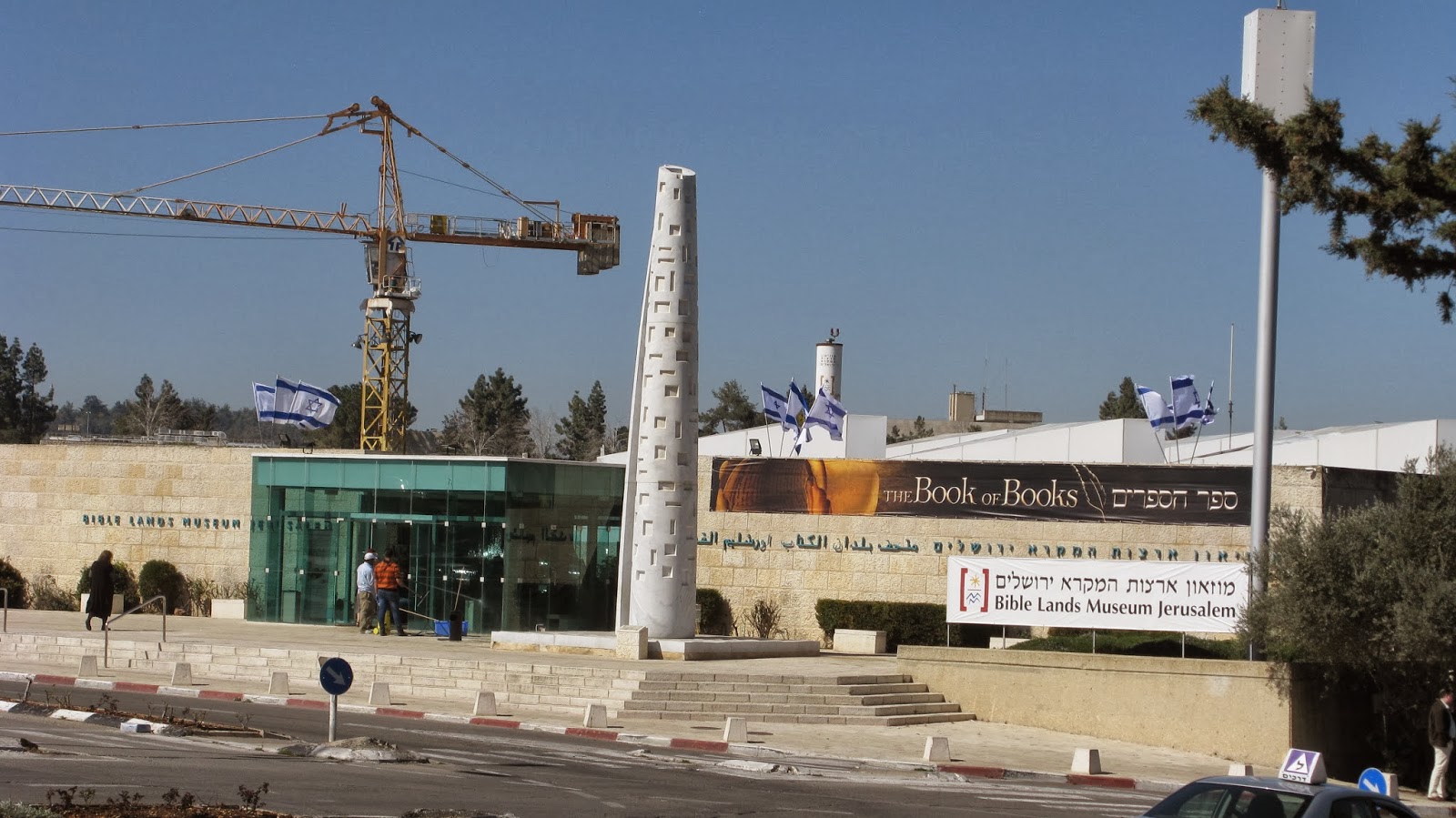
The Book of Books


"With extraordinary exhibitions and one of the world's finest collections of Ancient Near Eastern art and archaeology, the Bible Lands Museum Jerusalem is dedicated to encouraging the understanding and appreciation of the roots of monotheism through its exhibitions, catalogs and programs."


I went to see a new exhibition at the museum:  The Book of Books, which is being shown in cooperation with Verbum Domini, "a network of international exhibitions that celebrate history’s most influential book—the Bible. Each exhibit features a unique assemblage of Roman Catholic, Orthodox, Protestant, and Jewish treasures, displayed against immersive backgrounds, to tell the story of the Judeo-Christian Scriptures throughout the ages.
The Verbum Domini exhibition series was inspired by Pope Benedict XVI’s vision of renewed religious passion for the “Word of the Lord.” The first Verbum Domini exhibit was held at the Vatican in the spring of 2012. Since then, exhibitions focusing on different aspects of the Bible’s extensive history have been held around the world, from Cuba to Israel and beyond.
Verbum Domini exhibits feature items from The Green Collection—one of the world’s largest private collections of rare biblical texts and artifacts—as well as significant pieces from the collections of major public institutions and other private collections worldwide."

I was mainly interested in the Jewish treasures, which included:


 Some books from Yemen produced in the 15th and 16th century.  These are handwritten, ink on paper renditions of the Pentateuch.


Incantation bowls from 5th century to 8th century Iraq.  These are often referred to as "magic bowls," because a circular formula was written in Aramaic which was thought to drive away evil spirits.  One is inscribed with the words of Isiah 22:8:  "And he discovered the covering of Yehudah, and you did look in that day to the armor of the house of the forest."


With Purim just around the corner, these Megillot caught my eye.  The first is an illuminated scroll from Ferrara, Italy from about 1615.  The second is from 19th century Morocco.  It's ink on parchment, and the silver work on the case probably took almost as much attention to detail as the scroll.


The exhibit also include fragments from the Cairo Geniza and original pages from the Gutenberg Bible, as well as many examples of the New Testament and illuminated Gospels.

The rest of the museum is home to collections of Etruscan, Greek and Roman artifacts, as well as Egyptian and Babylonian relics.  

Tuesday, February 11, 2014

A Rabbi, a Friend and the Benefit of the Doubt


Yehoshua ben Perachiah and Nitai HaArbeli received (Torah) from them. Yehoshua ben Perachiah said: "Make yourself a teacher; acquire a friend; and judge every person favorably."(Ethics of the Fathers 1:6)


It would seem my recent reading falls into these categories:

Make yourself a teacher (aseh lecha rav)
Former President William Clinton made Rabbi Genack his rabbi.  He asserts that although he is a Southern Baptist, "[Rabbi Genack] has been a trusted guide on matters of leadership, justice and faith." Rabbi Genack, a Talmudic scholar, chief executive officer of the Orthodox Union's Kashruth Division and a congregational rabbi, met Clinton when the former President began his campaign for the White House.  "As their friendship deepened, the rabbi started sending Clinton brief essays highlighting spiritual insights from the Bible.  Later, at Clinton's request, [Rabbi] Genack took a more formal approach, also inviting many distinguished acquaintances to contribute."  These include Rabbi Lord Jonathan Sacks, former Chief Rabbi of the United Hebrew Congregations of the Commonwealth; Noa Rothman, Yitzchak Rabin's granddaughter; and noted American rabbis and Jewish scholars.

The result is Letters to President Clinton: Biblical Lessons on Faith and Leadership by Menachem Genack and Bill Clinton (Sterling Ethos, 2013). It was a finalist in the Anthologies and Collections category of the 2013 National Jewish Book Awards.

Okay, not my favorite book.  Maybe it's because I was a Republican, and there is quite a bit of Bush-bashing. There's also plenty of political rigmarole, like "it is ironic that President Clinton is often assaulted by his Republican critics for waffling and changing policy, when his ability to adjust to new circumstances and political reality, while remaining true to his basic vision is the mark of real leadership." Maybe it's because I don't relate to explaining things from a Jewish perspective to a Baptist.  There are some bright spots:  Rabbi Sacks' letter about "Influence or Power?" was insightful; Jeremy Dauber's discussion of cities was relevant to Clinton's move to New York. But more than that I think of the people involved with the Clintons who suffered mysterious deaths:  Vince Foster, Mary Mahoney, James McDougal, Ron Brown, etc. When I read about Queen Esther facing Achashveros, "an innocent girl, ripped from the bosom of her family, unschooled in the art of diplomacy, and unacquainted with the intrigues of a royal court," all I could think of was Monica Lewinsky, the blue dress, and the leader of the free world saying "I did have a relationship with Miss Lewinsky that was not appropriate."

Acquire a friend (u'k'ne lecha chaver)

I thought this would be a good read for someone moving to a new area, and I was right.  The author had 52 "dates" in which she tried to find a good, local friend with whom to get together spontaneously.  She did some research by reading books about friendship, and she set herself rules about how she would meet people.  Bersche lives in Chicago, so she had her pick of a lot of restaurants, social events, etc.  Although not religious, she joined a group for young Jewish leaders.  She also took a cooking class and an improv class at Second City.  Bertsche even used "friend services" in her research.

So what have I done on my friend quest?  I've joined a book club, I meet a friend for coffee once a month, and I go to a weekly prayer group.  Still on the list:  an exercise class, organizing a craft group, and volunteering at the library.  I've tried to stay in touch with the people in my Ulpan class, and I am blessed with amazing neighbors who are also very convenient friends.

And judge every person favorably (v'hevey dan et kol adam l'chaf zchus)

"dan l'chaf zchus" sometimes translates to "give the benefit of the doubt."

There are a few books in this category that are on my reading list:
The Other Side of the Story:  Giving People the Benefit of the Doubt -- Stories and Strategies by Yehudis Samet (Artscroll, 1996)

Also by Yehudis Samet - It Wasn't How It Seemed:  True stories about People Who Jumped to Conclusions (Shaar Press, 2001)

and Benefit of the Doubt:  Breaking the Idol of Certainty by Gregory A. Boyd (Baker Books, 2013), in which this Christian pastor "invites readers to embrace a faith that doesn't strive for certainty, but rather for commitment in the midst of uncertainty. Boyd rejects the idea that a person's faith is as strong as it is certain. In fact, he makes the case that doubt can enhance faith and that seeking certainty is harming many in today's church."

But I've also giving the benefit of the doubt to several books that would not normally be on my reading list.

The aforementioned book club has chosen A Soldier of the Great War by Mark Helprin.  My copy is 860 pages long.  It's about an old man walking on the road with a young factory worker.  As they walk, the man tells the story of his life.  Instead of being off put by the number of pages, the subject matter, or the "My Dinner with Andre"-like, one long conversation about life format, I decided to give the book a chance, and I'm really enjoying it.


Koren recently published Derash Yehonatan: Around the Year with Rav Yehonatan Eybeshitz by Shalom Hammer.  Ravi Yehonatan died in 1764, and Rabbi Hammer has endeavored to "popularize the teachings of Rav Yehonatan and make them accessible to a broader audience."  He chose selections that he felt were the most pertinent and poignant.  This Rabbi lived in what is now Denmark, had a disagreement with another rabbi that divided the Jewish community and lived in the 1700s.  I asked myself if there might be anything in the book that was pertinent and poignant to me.  I was pleasantly surprised to find writings about Jewish activism and "the requirement of every Jew to long to be in the Land of Israel."  Rabbi Hammer notes that "those who cannot actualize Aliya should at least anticipate the day when they can join Am Yisrael in their land.  Those fortunate enough to live in the land should appreciate the opportunity given them."  My roommate from my freshman year in college was visiting on her most recent trip of many to Israel.  It was great to see her, someone who loves Israel and shows it through frequent visits and support, and to appreciate how far we've both come since our freshman year in college, when making Aliya was a small hope, and I am now fortunate to live in this beautiful country.


Sunday, January 19, 2014

Like Dreamers

"When God will return the captivity of Zion, we will be like dreamers." (Psalm 126, verse 1)


Like Dreamers:  The Story of the Israeli Paratroopers Who Reunited Jerusalem and Divided a Nation by Yossi Klein Halevi is the 2013 National Jewish Book Award winner of the Everett Family Foundation Award for Jewish Book of the Year.  Mr. Halevi is also the winner of the 2014 Sophie Brody Medal, awarded by the American Library Association to the "author of the most distinguised contribution to Jewish literature for adults published in the United States in the preceding year."  Although the book cover is graced by David Rubinger's iconic photograph of  Zion Karasanti, Yitzhak Yifat and Haim Oshri by the Western Wall shortly after its capture on June 7th, 1967, the book is not about these three soldiers.  

It centers on seven of the soldiers that fought and reclaimed Jerusalem:  Arik Achmon, Udi Aviv, Meir Ariel, Avital Geva, Yoel Bin-Nun, Yisrael Harel, and Hanan Porat.  Moreover, it looks at the Kibbutz Movement and the Religious Zionist Movement and how ideologies and "dreams of Zion" influenced these men not only in battle, but in their lives after the war. For someone who favors literary fiction, this history of modern Israel, told through the lives of its history makers, was fascinating and informative. 

Avital Geva articulates one of the Zionist dreams.  "Could there be greater joy than working the fields with one's closest friends and sharing food grown by their kibbutz?" Others espoused the philosophy of Rabbi Kook, that "the spiritual failure of the religious provoked the rebellion of the secular who, however inadvertently, were preparing the way for the next, higher stage of religious evolution by restoring the holy people to the holy land."

There is a riveting account of the battle for the Old City, which tempers the ebullient cry of "Har Habait B'Yadenu" (The Temple Mount is in our hands) with the number of those who died or were wounded in securing the victory. 

Halevi follows the seven soldiers' lives after the war, their personal endeavors, changing ideologies and politics, as well as their relationships with one another.  It was also interesting to read Halevi's assessment of Ariel Sharon in light of Sharon's recent death:  "Ever since he was a boy, Sharon had been an outsider.  In this farming village, Kfar Malal, his parents were so estranged from their neighbors that he had grown up without knowing what the inside of this friends' homes looked like.  In the army he'd been repeatedly denied promotions for which he was most qualified.  He's reckless and untrustworthy, opponents said his military exploits leave behind too many bodies.  Supporters, though, regarded him as a savior, the IDF's most brilliant commander, inspiring his men to victory.  And when the country was in desperate need, whether to stop terrorist incursions in the 1950's or defeat the Egyptians in 1973, it invariably turned to Sharon.  And then, invariably, rejected him."

There were also some eerie predictions:  And he [Sharon] warned that handing control of most of Gaza to Arafat would lead to Katyushas on neighboring Israeli towns like Ashkelon and Ashdod.  Arik Achmon laughed when he hear that one, Katyushas on Ashkelon!"  Although it wasn't so funny when they closed schools in Ashdod and Ashkeon on January 17, 2014 because of the escalation of rocket fire on both cities.

The book ends in 2004, with Yoel Bin-Nun commemorating Jerusalem Day, the holiday celebrating the reunification of the city in 1967,  as he did every year:  by taking his students on an all-night walking tour of the battleground, from Ammunition Hill, passed the pre-1967 borders,  around the wall of the Old City and up to the Western Wall.  It is at this point that the verse from Psalms again echoes:  "Everything had seemed so clear then, in the summer of '67, when Israel had abruptly emerged from the nightmare of annihilation into the dream of redemption." At that moment, who could foresee the complications and challenges Israel deals with now?

In an interview with Seth J. Frantzman in The Jerusalem Post (September 27, 2013),  Halevi said that "when you go back and you experience the origins of these movements, there is something thrilling about discovering the details, and suddenly you feel the Israeli story in a different way." Thank you for sharing your discoveries with the reading public.

I attended the "Israeli Book Launch" on Sunday, January 19th.  It was a great event for a number of reasons.  First, because Yossi Klein Halevi discussed the book with Saul Singer (co-author of Start-Up Nation). 


The author gave some insights into his 11-year journey writing the book and the importance of the "soundtrack" accompanying the history of the modern State of Israel. Second, the event was presented by the Highlight Foundation, whose mission is to create awareness, encourage financial support, and volunteering to worthy causes in Israel -- while sharing an unforgettable, social and fun experience.  Extra points for Ruth for remembering my name and checking on the kashrut of the soup that was served. Third, the evening benefited Jerusalem Village, an organization with the goals of providing newcomers with an outlet where they can make an impact on their community and grow their social network; expanding the opportunities for newcomers to have high quality, authentic, social experiences; and encouraging young Jewish adults from all over the world to choose Jerusalem as a destination by creating a welcoming culture.

Finally, and heartfelt to me, the event took place at the First Station, the hip new meeting place in Jerusalem in the refurbished Ottoman building and grounds (see E-reading and Jerusalem for more about the old train station). It was amazing to be sitting and hearing about the Six Day War less just a three-minute walk from where the fighting took place. It was definitely worth braving the chilly Jerusalem air for this memorable evening.

(The Train Station and the Khan Theater are located in the bottom right on the map).