Showing posts with label Babka Boulou & Blintzes. Show all posts

Monday, September 5, 2022

Elul 5782

As Rosh Hashanah approaches, our preparations for the New Year accelerate during the month of Elul: shopping, cooking and baking, and preparing both emotionally and spiritually. It's also a good time to review the past year, noting both accomplishments and areas that can use some improvement, and then plan for the New Year. At Life Is Like a Library, some of the many books we've read over the past year are particularly apropos for Elul:

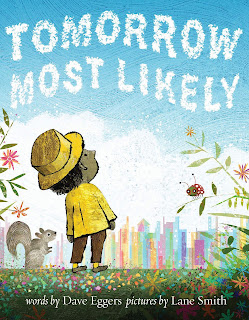
Two great children's books remind us to think positive. In Tomorrow Most Likely by Dave Eggers (Chronicle Books, 2019), a boy starts out with the assertion that "tomorrow most likely there will be a sky. And chances are it will be blue." As he goes through his day, he reassures himself of other things that are most likely tomorrow, like squirrels and airplanes, and finding rocks, but also riding whales and eating clouds. Lane Smith's amazing illustrations make this book a visual delight, and the comfort of things that are "most likely" is a perfect message to keep in mind in the coming year. 
Shinsuke Yoshitake's There Must Be More Than That! (Chronicle Books, 2020) also has a great message for Elul. "Grown-ups often tell you to choose one of two things. But if neither of them seems right...there are more choices over here!" Little sister's imagination goes wild with the possibilities. From reassuring to ridiculous, we must remember there are always more than two options.
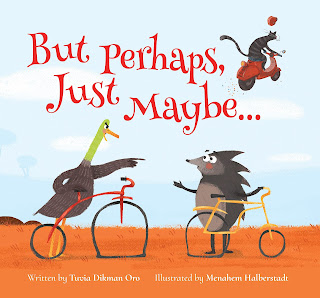
But Perhaps. Just Maybe... (Green Bean Books, 2022) was one of our favorite children's books this year. The combination of cute illustrations and mussar (character development lesson) is a winner. Bonus points that the lesson is directly from Pirke Avot -- giving the benefit of the doubt.


And yet another Green Bean Book based on a verse from Tanach - Nuri and the Whale. Written by Ronit Chacham, translated by Mekella Broomberg and illustrated by Oran Yogev, it tells the story of, well, Nuri and the Whale. Nuri follows his father's advice, taken from the Book of Ecclesiastes (Kohelet): "Cast your bread on the water, and one day it will come back to you" (11:1). He feeds a little fish every day, and soon the fish grows big. The fish takes him to see the Wisewhale -- the King of the Sea. Wisewhale gives Nuri the ability to understand the language of animals and gives him some parting words,"Know that there will be days to come when you will give and take -- and you will be both happy and sad." Some interesting things happen to Nuri, and he passes his sage advice to his grandchildren: "Those who open their hearts will be rewarded in the end. What will the reward be? Sometimes treasure, sometimes a smile, and sometimes a joyful heart." What a great message to start the year. The gorgeous illustrations bring the story to life.


Brene Brown's The Gifts of Imperfection (20th Anniversary Edition, Random House, 2020)is a must read, and it's a perfect book for Elul. Brown encourages everyone to strive for wholeheartedness. She provides ten guideposts to help you get there, and each guidepost has suggestions for Digging Deep -- Getting Deliberate, Getting Inspired, and Getting Going. The guideposts include cultivating self-compassion, cultivating calm and stillness, doing meaningful work (even if you are not paid in currency) and cultivating laughter, song and dance. 


The Hired Girl
by Laura Amy Schlitz, the 2016 Sydney Taylor Book Award Winner for Teen Readers, is the story of Joan/Janet, a farm girl who escapes the drudgery of her life of chores and becomes a hired girl to a Jewish family in Baltimore. There are so many wonderful aspects of this book that include Joan's honest and romantic personality, history and aspects of life in the early 1900s, and Joan's appreciation of Judaism as she works for the family. But I found this to be such an "Elul book." Joan/Janet is always inspiring -- to read more books, to learn, to become a better Catholic, and to be helpful to other people. And isn't that what Elul is all about?!

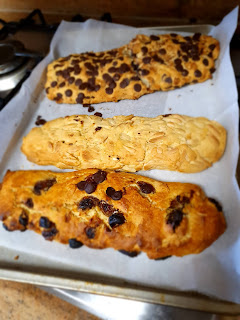
And one more time...Boulou, the sweet bread or cake that Jews of North African (Libya, Tunisia) origin traditionally eat during the month of Tishrei. (From Babka, Boulou & Blintzes: Jewish Chocolate Recipes from Around the World (Green Bean Books, 2021)


BOULOU


from Fabienne Viner-Luzzato (www.fabienneshomecooking.com)


Makes 3 boulou (each one will cut into several slices; number of slices depends on thickness)
Prep time: 30 minutes
Cook time: 15-20 minutes


Ingredients


2 large eggs (2 extra-large eggs in the US)
150 g/5 1/2 oz/3/4 cup sugar
2 teaspoons vanilla sugar
125 ml/4 fl oz/1/2 cup vegetable or sunflower oil
about 500 g/1 lb. 2 oz/ 3 3/4 cups self-raising flour (extra for dusting)
100 g/3 1/2 oz/2/3 cup dark chocolate chips
50g/ 1 3/4 oz/ 1/3 cup raisins
50 g/1 3/4 oz/1/3 cup flaked almonds


1. Preheat the oven to 200 degrees Celsius/180 degrees Celsius fan/400 degrees Fahrenheit/Gas Mark 6. Line a baking sheet with non-stick baking paper.


2. Place the eggs, both sugars and the vegetable or sunflower oil in a mixing bowl and mix together using a fork. Start adding the flour slowly, mixing with your hands to form a dough. Mix the flour in well, avoiding leaving behind lumps of flour. Add enough flour to make a soft dough -- the consistency of the dough needs to be soft, easy to touch but still slightly sticky.


3. On the work surface, divide your dough into three equal portions to make three different flavored boulou. Add the chocolate chips to one portion of dough, the raisins to another and the flaked almonds to the final portion of dough, kneading each flavoring into the dough until evenly distributed. Cook's Tip: If you prefer, you can mix all the flavoring ingredients together (the chocolate chips, raisins and almonds), then simply divide this mixture into three and knead one portion into each portion of dough.


4. Roll the flavored portions of dough into three equal-length logs (you might need to dust the work surface with a little flour first) and then flatten each one into a rectangle about 5 cm/2-inch wide and 15-20 cm/6-8-inch long, then place on the lined baking sheet.


5. Bake for 15-20 minutes, until they become golden brown. Remove from the oven and transfer to a wire rack, then leave to cool completely. Once cool, cut into 2 cm/3/4-inch thick slices to serve (or you can cut them into thinner slices, if you prefer).


6. Store the baked logs in an airtight container at room temperature for up to 4-5 days, and slice them, as needed. They will keep for longer, but will dry a little -- but they will still taste amazing dipped in hot black coffee!


As for the Real Cats of Israel, they are also excited for Elul, anticipating lots of delicious food scraps from all the cooking and baking:


Happy Reading!

Wednesday, February 9, 2022

Eat Chocolate on Days that End in "y"

Here at Life Is Like a Library, we don't celebrate or observe secular, Hallmark holidays. Thanksgiving for us, for example, is not the fourth Thursday in November, it is every possible minute of every day. "Were our mouth as full of song as the sea, and our tongue as full of joyous song as its multitude of waves, and our lips as full of praise as the breadth of heavens, and our eyes as brilliant as the sun and the moon, and our hands as outspread as eagles of the sky and our feet as swift as hinds -- we still could not thank You (God) sufficiently, and to bless Your Name for even one of the thousand thousand, thousands of thousands and myriad myriads of favors that You performed for our ancestors and for us" (Morning Service for Sabbath and Festivals).

Next. St. Valentine's Day is the day this early Christian clergyman was martyred by the Romans in 269 CE. He became the patron saint of love, marriage, and affianced couples, and also of beekeepers and epileptics. According to one source, Valentine's Day "might have been a Christianized version of Lupercalia, an ancient post-winter-early-spring Roman fertility and purification festival that was observed on February 15th in which boys slapped women with bloody goat's hides." February 14th is actually a very sad day for Jews. In 1349, the Massacre of Strausbourg took place. The locals blamed the Jews for many things: the Bubonic plague (Black Death), poisoning wells, price fluctuations.  The community was imprisoned, and driven by a mob to the cemetery, where 2,000 Jews were burned to death in a pyre. Their valuables were stolen, and, or course, all debts owed to the Jews were canceled. So no, we do not send cards or flowers or go to fancy restaurants for dinner or give each other big boxes of chocolate.

But much like the way we celebrate thanksgiving, every day is a good day to eat chocolate, and while the above story is rather grim, the new book from Green Bean Books, The Chocolate King is a cute tale of how Jews introduced chocolate in France. Written by Michael Leventhal and Illustrated by Laura Catalán, it is the story of young Benjamin, who dreams of making chocolate like his grandfather Marco, who made a thick, dark beverage of hot chocolate. Without gory details, Marco explains to Benjamin how their family had to leave Spain, with as many cocoa beans as they could take, and move to France. There, people were not familiar with chocolate. How they discover how delicious it is, thanks to Benjamin, is the climax of the story. While there is no overt Jewish content in the book, it is based on historical fact. As a librarian, I appreciated the "Bite-Sized History of Chocolate and the Jewish Community," a pictorial timeline that starts with the Mayans around 600 CE and ends with Bayonne as the chocolate capital of France. Another pictorial shows the production of chocolate "From Bean to Bar." And, completing the backmatter is a recipe for "Thick Hot Chocolate Drink" -- Chocolate a La Taza -- by Claudia Roden. 

As long as we are celebrating chocolate, be sure to check out Michael's collection of chocolate recipes, Babka, Boulou & Blintzes. We recently shared the recipe for Boulou, which are even more delicious when they are dipped in a mug of hot chocolate. 

Here's a basic recipe for hot chocolate from Celebrating Sweets:

Homemade Hot Chocolate

Makes 1 serving:

1 cup milk

1 cup unsweetened cocoa powder

1 Tablespoon sugar

2 Tablespoons chocolate chips

1-2 drops vanilla extract

Place milk, cocoa powder, and sugar in a small saucepan, and heat over medium/medium-low heat, whisking frequently, until warm, but NOT boiling. Add chocolate chips and whisk constantly until the chocolate chips are melted and distributed evenly into the milk. Add vanilla extract and serve immediately.


As for the Real Cats of Israel, they eat everything but chocolate (It can be lethal for them. Interesting fact: theobromine is the toxic agent and can cause abnormal heart rhythm, seizures, and death). But this guy reminded me of one of my favorite combinations -- chocolate and peanut butter. Reese was last seen dumpster diving in the municipal parking lot.


Enjoy chocolate every day!
Happy reading!