Showing posts with label kosher. Show all posts

Friday, December 11, 2015

THE SECRET'S OUT (AGAIN)!


In Secret Restaurant Recipes (Mesorah, 2014), Leah Schapiro and Victoria Dwek learn the secrets of the best kosher restaurants around the world and pass them on to readers. Recipes include Deviled Kale Salad, Duck with Sour Cherry Reduction, and other sumptuous dishes.


In Everyday Secret Restaurant Recipes (Mesorah, 2015), the dynamic duo of kosher cookbooks present recipes "from you favorite kosher cafes, takeouts and restaurants." Using the same format, there are chapters for Starters and Sides, Soups and Salads, Sandwiches, Chicken and Meat, Fish, Brunch and Lunch, and Baked Goods and Desserts. In the Table of Contents, each recipe is listed with the restaurant where it was created; the back matter includes a list of restaurants by country, state, and city, and a detailed index.

The recipes are presented on double spreads with clear color photographs that will have our mouth watering -- Morning Scramble from Boeuf and Bun in Brooklyn, made with with a burger, beef fry, an egg (on a bun) with sauteed mushrooms, potato sticks and horseradish mayo quickly comes to mind. The assembly of this one is beyond my culinary skills, but the Harvest Twist Salad from  The Pantry in Toronto, made with sweet potato and feta (yum!), served with a Tomato Rice Soup from the Sunflower Cafe in Brooklyn, makes for an easy weeknight meal. A Tuna Melt (from Bagels and Greens in Brooklyn) becomes a gourmet meal with a cheese/garlic sauce and made with tortillas. And as for inventive names, the Cali Love Panini from Holy Schnitzel is made with chicken breast, roasted eggplant and a pesto mayonnaise, topped with avocado and sun-dried tomatoes (good thing you can't see drool on the computer as I think about making these for dinner). The Asian Noodle Salad from Rimon in Israel sounds amazing, although I would probably skip the housemade teriyaki sauce and use my mother's, z"l, secret recipe. Zucchini Pasta, sometimes called "Zoodles," is full of vegetables (from Alice's in Brooklyn), and in the comfort of my home, I would not have to go across town to Crawford's to get a Creme Brulee Freezer.

How about some authentic Gong Bao Chicken from Dini's in Beijing?

1 lb chicken breast, cubed

3 Tbsp cornstarch
2 Tbsp water
Pinch coarse black pepper
oil, for frying
2 Chinese leeks or scallions
3 Tbsp salted peanuts
Sauce:
2 tsp soy sauce
2 Tbsp sugar
4 tsp vinegar
2 tsp hot sauce
4 tsp ketchup

Place chicken into a small bowl. Sprinkle with cornstarch; top with water and black pepper. Mix to coat the chicken. Let stand for 2 minutes.
Meanwhile, heat oil in a wok or sauté pan over high heat. When oil is very hot, add chicken cubes in batches; fry for 4-5 minutes. Remove from pan and drain on paper towels.
Drain oil from the pan. Add soy sauce, sugar, vinegar, hot sauce, and ketchup. Cook until sauce thickens slightly, 2-3 minutes. Add chicken and scallions; toss to coat. Top with peanuts.
Tidbit: Dini makes her own version of hot chili sauce to use in the restaurant. She says it’s the Asian equivalent of Israeli red schug.

Home Cook: We’ve tested this with all different types of hot sauce and they’ve all been successful. Halve the quantity if serving this dish to children.
Recipe from Everyday Secret Restaurant Recipes by Leah Schapira and Victoria Dwek
Reprinted with permission from the copyright holders: ArtScroll/Mesorah Publications


There are tips for home cooks, interesting descriptions of the restaurants, and insightful advice between the chapters about cooking fish, plating, and sandwich tips. The chefs who shared their secret neither received nor gave remuneration ($$) for the inclusion of recipes in this volume.

On the one hand, part of the restaurant experience is eating things that you cannot or would not prepare at home due to lack of time, equipment or inclination. Some of the recipes require ingredients that are not available in some places -- golden tomatoes, artisanal breads, and more unusual kosher fish.

On the other hand, its very cool to recreate favorite dishes in your own kitchen and impress family and friends with tastes and textures from restaurants. My rule of thumb is usually no more than 10 ingredients and no more than 5 steps in the instructions, and happily, most of these recipes conform, so I will be using it quite often. It is a rather large tome (336 pages), so it will be a challenge as I keep it FAR from the cooking area. For those of us who don't get out much, Everyday Secret Restaurant Recipes is a great way to travel the world of kosher cuisine.
!בתיאבון
(Be-tai-avon - healthy appetite in Hebrew)

As always, some real cats of Israel:


Happy Hanukkah!
Happy Reading!


Sunday, October 6, 2013

Start With This


Recent kosher cookbooks have set a standard of expectation:

  • interesting "main stream" or "gourmet" recipes (not a kugel to be had!)
  • the latest "in" ingredients like quinoa, tilapia, etc.
  • mouth-watering color photographs
  • clear layout with different fonts in different colors and enough white space to read the recipe clearly
  • detailed index
  • "bonus" information about measurements, substitutions, cooking techniques, appropriate wines or the like.

To this, I had my own checklist:

  • consistency - all measurements are either in volume, ounces or grams. Bonus points if the volume measurements are also converted to grams for those who live in Israel.
  • no more than 10 ingredients
  • no more than 6 steps to make the recipe
  • easily obtainable, reasonably priced ingredients that will be used in other recipes
  • something a little out of the ordinary for the Sabbath or a holiday, but not too weird
  • things my family will eat.


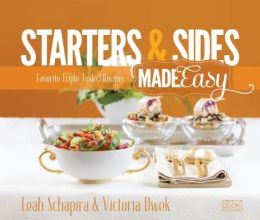
Leah Schapira and Victoria Dwek's latest book, Starters & Sides Made Easy, has earned the coveted 12 checks. It continues in the tradition of their joint effort, Passover Made Easy, and Leah's solo effort Fresh & Easy Kosher Cooking. These busy ladies are also the editors of the Whisk section of Ami Living, and maintain a website, www.cookkosher.com, with recipes, serving suggestions and travel tips.

Starters & Sides Made EasyAs my Mancunian neighbor (who is not a perfectionist; she just likes to do things properly) would say with her ever so lovely accent, "starters are a very important part of the meal. They set the tone for the whole seudah (festive meal)."

Shall I extol the virtues of this jam-packed little gem? Why not?! Let's start at the beginning. This is a paperback with what some call a "french fold" cover, so you can hold your place in the book. I love a big heavy cookbook as much as the next person, but when you think about it, how many recipes do you really use out of those huge tomes, and how hard is it to follow the recipe when you keep the book far away from the cooking space for fear of staining it? The $15.99 suggested retail price will make a small dent in your wallet but a big impact on your menu. The recipes are arranged in sections by main ingredient, which makes it easy for those of us who think, "I'd like to serve a vegetable as a first course" or "I'd like to try a new grain instead of the rice or kugel I always serve."

In the acknowledgments, the first mention is Hashem (God). The second mention is family. Just as the starter sets the tone of the meal, starting with this appreciation sets the tone of the cookbook as more than just a collection of recipes, but as an inspired effort.

The introduction is a conversation between Victoria and Leah, complete with speech bubbles. These ladies are passionate about their cooking, but as the same time are aware of the needs of those who aren't so enamored. A colorful Spice Guide follows. The numbering is a little hard to follow on the first pages, but if you don't know your spices, you should learn them by now!

One of the nicest features of the cookbook is "Building Blocks." These are quick tips to help you either expand a recipe or think out of the box. Instead of plain mashed potatoes,  you can leave the skin on, add garlic or onions, or use different vegetables, like sweet potatoes or broccoli.Other "Building Blocks" offer suggestions for rice, and roasted vegetables. It's like getting even more recipes for free!

This versatility extends to all the recipes. Things like "Chessy Onion Rolls," "Barbecue Noodles," and "Terriyaki Mushrooms" work well as either starters or sides. While some of the meat and fish dishes may not be perfect as sides, never fear! There are instructions at the back of the book for making several recipes into "mains," some as simply as adjusting portion size or serving over rice.

It seems this cookbook was published just for me. Each recipe is presented on a double spread, with the  ingredients and instructions on the left, as well as the number of servings and some tips and tidbits (Who knew that in the past, the most common variety of eggplant was small, round and white and actually looked like an egg?). The right side of the spread includes the clear color photo, how to plan ahead (prepare the sauce, freeze dough to use later), as well as a note that could be a serving idea or an anecdote.

Finally, for those who enjoy the aesthetics of food, there are plating ideas and serving ideas that include little cups made out of egg roll wrappers and stacking and arranging methods. I learned the scallion curling method from my Mancunian neighbor; it's a great way to add a little color.

As a responsible reviewer, I needed to try out several recipes, even though they are "triple-tested." The Terriyaki Mushrooms were very tasty - my crowd preferred them over a bed of rice.  I would make a big batch and use this one as a side instead of a starter. The Barbecue Noodles were "interesting," which meant some liked the novelty of a new dish, others thought they were very tasty, and still others were trying to be polite, but were not thrilled. Overall, a big success for eaters who like to eat the same thing every week.
  
 Bitayavon! (Hearty appetite in Hebrew)