Monday, December 12, 2022

JEWISH BOOK CARNIVAL - DECEMBER 2022


Life Is Like a Library is honored to host the December Jewish Book Carnival -- a monthly round up of links from across the blogosphere. It includes book reviews, author interviews, essays and other posts related to Jewish books. 

The purposes of the Jewish Book Carnival are to build community among bloggers who feature Jewish books and their blogs, and to promote Jewish reading and fields supporting this reading such as publishing and library services.

This month Gila Green Writes hosts author Haviva Ner-David who shares her experience of novel writing and tries to answer the question: What Is Fiction Writing About, After All?

On The Book of Life Podcast, Heidi Rabinowitz interviews two Sephardic authors, Bridget Hodder (The Button Box) and Sarah Aroeste (Buen Shabat, Shabbat Shalom). It's Always a Party with a Sephardi!

The Sydney Taylor Shmooze has plenty of Hanukkah book reviews, including this review of Hanukkah at Monica's by Varda Livney, reviewed by Rinat Hadad Siegel.

The Association of Jewish Libraries has published an open statement against book banning on their blog, People of the Books.

On her blog Book Q&As with Deborah Kalb, Deborah interviewed Rabbi Deborah R. Prinz about her new children's picture book, The Boston Chocolate Party.

At Jewish Books for Kids... and More, Barbara Bietz shares a Hanukkah book roundup.

Sarah Lavane, author of Unmatched: An Orthodox Jewish Woman's Mystifying Journey to Find Marriage and Meaning, talks to Michael Feldstein from Jewish Link about shidduch resumes, matchmakers and Orthodox singles.

On her My Machberet blog, Erika Dreifus routinely compiles news of Jewish literary interest. Here's one recent post: Jewish Literary Links.

In Tablet Magazine, Rachel Fremmer picks The Best Jewish Children's Books 0f 2022

And at Life Is Like a Library, Winter in Israel means bird migration and hot soup.

Happy Hanukkah!


Thursday, December 8, 2022

Winter in Israel

 When the weather turns cold in Israel, a few things happen. It starts to rain, birds start their migration from Europe and Asia to Africa, the supermarket puts away the "artiks" (sugar-water ices) and put out the Krembo, and I eat a lot of soup.

While I could wax poetic about the deliciousness of Krembo, the chocolate-covered marshmallow sitting on a cookie, there are no books about them...yet. But there are some great books about the bird migration through Israel:


Anna Levine's All Eyes on Alexandra (Kar-Ben, 2018) is about a crane who flies to the beat of a different drummer, but when leadership is needed to get the flock where they need to go, Alexandra takes charge. Chiara Pasqualotto's illustrations capture the grace of the big birds in the air.


Tami Lehman-Wilzig's new book with Rabbi Deborah R. Prinz,  The Boston Chocolate Party (Apples and Honey, 2022) about chocolate and Hanukkah is getting a lot of buzz, but Stork's Landing (Kar-Ben, 2014) remains one of my favorites. When I reviewed it for the Association of Jewish Libraries Newsletter, I noted that "Simple, colorful illustrations complement the text, with the white and gray of the storks set against vibrant spring blossoms and muted shades of autumn skies. Several aspects of life in Israel enhance the story: the annual migration of birds and the cooperative community environment of the kibbutz."

An interesting selection, also published this year is Storky's Journal Home by Nachshon Meir Spiegelman (The Israel Center for Libraries). "Storky loses her way during her first migration, and finds herself in a wonderland, confused by the different people she meets, all of whom seem to share one story about the longest journey of all time. This is the Jewish people's story, through the bird's eyes."


And, of course, there is The Man Who Flies with Birds (Kar-Ben, 2009) by Carole G. Vogel and Yossi Leshem. Yossi was a Senior Researcher in the Department of Zoology in the Faculty of Life Sciences at Tel Aviv University and is the founder and Director of the International Center for the Study of Bird Migration. He has done amazing things in his field including tracking migratory storks with GPS and working with barn owls as pest control agents. The book explains how Yossi's knowledge of bird migration reduced air collisions by rerouting planes.


Winter is also a great time to warm comfort foods. When Michael Leventhal was kind enough to send me an advance copy of Silvia Nacamulli's Jewish Flavours of Italy: A Family Cookbook (Green Bean Books, 2023), I was fascinated by the introductory chapter about the history of Jews in Italy -- in some cases dating back to the destruction of the Second Temple. But as I looked through the recipes, there weren't too many my family would be adventurous enough to try because of ingredients like anchovies and pine nuts. But I found one that is an ultimate comfort food: Minestra di Pasta e Patate (Pasta and Potato Soup) combines noodles, potatoes, and cheese. Don't tell my family that there are two anchovies!

Some other soups we'll be whipping up to warm us from the cold:

Thai Carrot Soup

Moosewood Gypsy Soup

Curried Carrot, Sweet Potato, and Ginger Soup


Happy Reading (and eating!)


Monday, September 5, 2022

Elul 5782

As Rosh Hashanah approaches, our preparations for the New Year accelerate during the month of Elul: shopping, cooking and baking, and preparing both emotionally and spiritually. It's also a good time to review the past year, noting both accomplishments and areas that can use some improvement, and then plan for the New Year. At Life Is Like a Library, some of the many books we've read over the past year are particularly apropos for Elul:

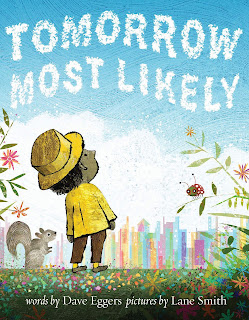
Two great children's books remind us to think positive. In Tomorrow Most Likely by Dave Eggers (Chronicle Books, 2019), a boy starts out with the assertion that "tomorrow most likely there will be a sky. And chances are it will be blue." As he goes through his day, he reassures himself of other things that are most likely tomorrow, like squirrels and airplanes, and finding rocks, but also riding whales and eating clouds. Lane Smith's amazing illustrations make this book a visual delight, and the comfort of things that are "most likely" is a perfect message to keep in mind in the coming year. 
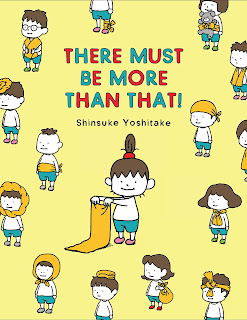
Shinsuke Yoshitake's There Must Be More Than That! (Chronicle Books, 2020) also has a great message for Elul. "Grown-ups often tell you to choose one of two things. But if neither of them seems right...there are more choices over here!" Little sister's imagination goes wild with the possibilities. From reassuring to ridiculous, we must remember there are always more than two options.

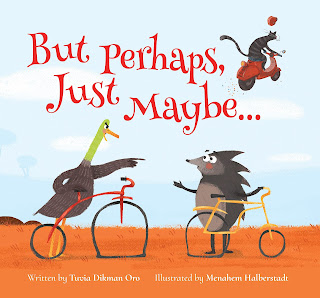
But Perhaps. Just Maybe... (Green Bean Books, 2022) was one of our favorite children's books this year. The combination of cute illustrations and mussar (character development lesson) is a winner. Bonus points that the lesson is directly from Pirke Avot -- giving the benefit of the doubt.

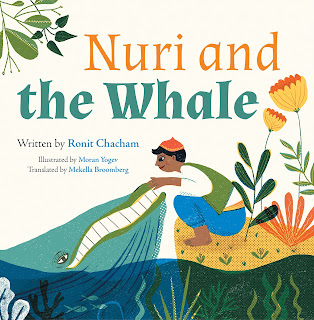
And yet another Green Bean Book based on a verse from Tanach - Nuri and the Whale. Written by Ronit Chacham, translated by Mekella Broomberg and illustrated by Oran Yogev, it tells the story of, well, Nuri and the Whale. Nuri follows his father's advice, taken from the Book of Ecclesiastes (Kohelet): "Cast your bread on the water, and one day it will come back to you" (11:1). He feeds a little fish every day, and soon the fish grows big. The fish takes him to see the Wisewhale -- the King of the Sea. Wisewhale gives Nuri the ability to understand the language of animals and gives him some parting words,"Know that there will be days to come when you will give and take -- and you will be both happy and sad." Some interesting things happen to Nuri, and he passes his sage advice to his grandchildren: "Those who open their hearts will be rewarded in the end. What will the reward be? Sometimes treasure, sometimes a smile, and sometimes a joyful heart." What a great message to start the year. The gorgeous illustrations bring the story to life.


Brene Brown's The Gifts of Imperfection (20th Anniversary Edition, Random House, 2020)is a must read, and it's a perfect book for Elul. Brown encourages everyone to strive for wholeheartedness. She provides ten guideposts to help you get there, and each guidepost has suggestions for Digging Deep -- Getting Deliberate, Getting Inspired, and Getting Going. The guideposts include cultivating self-compassion, cultivating calm and stillness, doing meaningful work (even if you are not paid in currency) and cultivating laughter, song and dance. 


The Hired Girl
by Laura Amy Schlitz, the 2016 Sydney Taylor Book Award Winner for Teen Readers, is the story of Joan/Janet, a farm girl who escapes the drudgery of her life of chores and becomes a hired girl to a Jewish family in Baltimore. There are so many wonderful aspects of this book that include Joan's honest and romantic personality, history and aspects of life in the early 1900s, and Joan's appreciation of Judaism as she works for the family. But I found this to be such an "Elul book." Joan/Janet is always inspiring -- to read more books, to learn, to become a better Catholic, and to be helpful to other people. And isn't that what Elul is all about?!

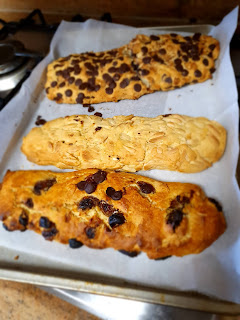
And one more time...Boulou, the sweet bread or cake that Jews of North African (Libya, Tunisia) origin traditionally eat during the month of Tishrei. (From Babka, Boulou & Blintzes: Jewish Chocolate Recipes from Around the World (Green Bean Books, 2021)


BOULOU


from Fabienne Viner-Luzzato (www.fabienneshomecooking.com)


Makes 3 boulou (each one will cut into several slices; number of slices depends on thickness)
Prep time: 30 minutes
Cook time: 15-20 minutes


Ingredients


2 large eggs (2 extra-large eggs in the US)
150 g/5 1/2 oz/3/4 cup sugar
2 teaspoons vanilla sugar
125 ml/4 fl oz/1/2 cup vegetable or sunflower oil
about 500 g/1 lb. 2 oz/ 3 3/4 cups self-raising flour (extra for dusting)
100 g/3 1/2 oz/2/3 cup dark chocolate chips
50g/ 1 3/4 oz/ 1/3 cup raisins
50 g/1 3/4 oz/1/3 cup flaked almonds


1. Preheat the oven to 200 degrees Celsius/180 degrees Celsius fan/400 degrees Fahrenheit/Gas Mark 6. Line a baking sheet with non-stick baking paper.


2. Place the eggs, both sugars and the vegetable or sunflower oil in a mixing bowl and mix together using a fork. Start adding the flour slowly, mixing with your hands to form a dough. Mix the flour in well, avoiding leaving behind lumps of flour. Add enough flour to make a soft dough -- the consistency of the dough needs to be soft, easy to touch but still slightly sticky.


3. On the work surface, divide your dough into three equal portions to make three different flavored boulou. Add the chocolate chips to one portion of dough, the raisins to another and the flaked almonds to the final portion of dough, kneading each flavoring into the dough until evenly distributed. Cook's Tip: If you prefer, you can mix all the flavoring ingredients together (the chocolate chips, raisins and almonds), then simply divide this mixture into three and knead one portion into each portion of dough.


4. Roll the flavored portions of dough into three equal-length logs (you might need to dust the work surface with a little flour first) and then flatten each one into a rectangle about 5 cm/2-inch wide and 15-20 cm/6-8-inch long, then place on the lined baking sheet.


5. Bake for 15-20 minutes, until they become golden brown. Remove from the oven and transfer to a wire rack, then leave to cool completely. Once cool, cut into 2 cm/3/4-inch thick slices to serve (or you can cut them into thinner slices, if you prefer).


6. Store the baked logs in an airtight container at room temperature for up to 4-5 days, and slice them, as needed. They will keep for longer, but will dry a little -- but they will still taste amazing dipped in hot black coffee!


As for the Real Cats of Israel, they are also excited for Elul, anticipating lots of delicious food scraps from all the cooking and baking:


Happy Reading!

Thursday, August 4, 2022

Between the Dire Straits - Bein HaMetzarim

 The three week period between the 17th of Tammuz and the 9th of Av is known as "Bein HaMetzarim" - between the dire straits, and it is the saddest period in the Jewish calendar. The custom is not to hold weddings, not to play or listen to live music, and not to cut hair or shave (as a sign of mourning). Because it is considered a time of misfortune, many avoid dangerous situations, such as travel or surgery. But, as always in Judaism, it is also a time to reflect and learn. So when we are between the "dire straits," we read a lot of Holocaust-related material:


Catherine Ehrlich writes about her grandparents' harrowing experiences in Austria before, during and after the Anschluss in Irma's Passport: One Woman, Two World Wars, and a Legacy of Courage (She Writes Press, 2021). Irma, Ehrlich's grandmother, was one of the rare women who attended university in the early 20th century. She and her first husband planned to go to England and study literature, but World War I started, and he was killed in combat. Heartbroken, Irma went to Vienna to teach. She encountered Jacob Ehrlich, whom she had known in their native Bohemia (Czech Republic). They married and had a son, Paul. Soon after, the Nazis arrived and made life miserable for the Jews. Catherine never knew her grandfather. As an active leader of the Jewish community, he was arrested and taken to Dachau, where he died. Irma was able to use her knowledge of languages and connections to escape to London with her son. She spoke to Jewish groups about the urgent need to save the Jews trapped in Nazi-occupied areas. After the World War II, she and Paul moved to the United States, where she eventually worked filing persecution claims for Holocaust survivors.

Irma literally lived history, and much of the book is about historical events. It is also interesting how many nationalist stirrings and Antisemitism there was even before World War I. Irma was a survivor, and her granddaughter combines Irma's account of her life, the historical events, and her own memories of this formidable lady to show that Irma refused to think of herself as a victim.


Subtitled "A Story of Resilience," A Child Without a Shadow (self-published, 2021) is the story of Shaul Harel. His family left Warsaw in 1932 for Brussels, where he was born Charles-David Hilsberg in 1937. When the Nazis invaded, he and his sister were separated from their parents and hidden with non-Jews. After World War II, he was sent to an orphanage, then a school, and immigrated to Israel when he was twelve. He served in the Israeli army, went to medical school, and became a renowned pediatric neurologist. This book contains a lot of reflection. Did Shaul's time as a hidden child, where his life was devoid of love, mental stimulation and fresh air, spur him to his achievements and his caring way with child patients? Another fascinating and inspiring story of someone who lived history. 


The Forgotten Memoirs
(by Esther Farbstein; Mesorah, 2011) may have the wrong title because the stories are unforgettable. Its subtitle, "Moving Personal Accounts from Rabbis Who Survived the Holocaust," gives the reader an idea of the content. Farbstein did extensive research and found that many rabbis published learned books after World War II, and in the introduction to the book or in an afterword, they described their experiences during the Holocaust. These introductions are the text of the book. Each story is unique, but there are some similarities: the rabbis' circuitous journeys through Europe to escape the Nazis, their concerns for their constituencies, and their adherence to Torah Judaism no matter the danger or challenge. It's a thick volume, but it is probably better to take breaks between each rabbi's account. 


The Vanishing
(Library Tales Publishing, 2022) by David Michael Slater is billed as "an unforgettable journey of redemption and revenge." The story starts when Sophie Siegel is eleven years old, and the situation for Jews in Germany is deteriorating quickly. As she hides from Nazis in a closet, she realizes she is invisible. Her primary goal is to keep her younger neighbor, Giddy, safe and alive. But as she moves from her village to the ghetto to a concentration camp, she learns that there are no rules, and no justice. Full of action and full of graphic detail of Nazi atrocities, the reader will root for Sophie and Giddy. 


Hopefully, this will be the last time we read Holocaust books during the Three Weeks because they will be transformed into days of joy!

As for the Real Cats of Israel, we've had quite a parade of feral cats, including Noga:


Meaningful reading!

Tuesday, July 12, 2022

Leaving Eastern Parkway


At Life Is Like a Library, we read a lot of books in the "Off the Derech (OTD) genre -- stories of religious Jews who decide to leave the Orthodox fold (See some selections in the AJL Bibliography Bank). That is the only spoiler we will give so that you can enjoy all the humor and irony in Matthew Daub's first novel. Available in September from Delpinium, the novel centers on Zev Atshul, a handball-playing fifteen-year old from Crown Heights Brooklyn. The story takes place in the early nineties, where Zev is conflicted about his love of handball and his place in the Lubavitcher Hasidic community. After a tragedy, for which Zev feels guilt, he goes to live with his sister in Urbana-Champaign, Illinois. Life in the Midwest is a challenge. But this resourceful teenager stumbles to find his way, making interesting friends and questioning God's mercy and justice.

Full disclosure (put no spoilers!): I had low expectations for this book. So many OTD books have stereotypical characters, especially the religious ones, who come off as crazed, hypocritical and cultish. And, of course, all the non-religious characters are wonderful and morally superior. The characters here were more nuanced, and Zev's relationship with a Reform Rabbi is a combination of both awkward and touching. Although the characters do walk down Eastern Parkway, the main drag in the Lubavitch community in Crown Heights, there is much more significant Jewish content and a Yiddish glossary at the end for all the words included. The author has also captured the cadence of speech easily recognizable in this Brooklyn enclave. The pacing is great. The story develops slowly but steadily and the mix of mundane and dramatic is just right. There is a strong sense of place in Brooklyn, Urbana, and Chicago (and another location!). The ending is satisfying -- not happily ever after, but one that makes sense for the story. As said, full of irony, some sadness, but lots of humor, including Zev trying to lose his Brooklyn cadence by watching and repeating after a television host.

Daub is a retired university art professor, and one wonders how much of his personal experience is reflected in the character of Paul in the novel.

I can't wait to discuss this one with super librarian and book group moderator Rachel Kamin!

As for the Real Cats of Israel, they are taking it easy in the summer heat:


Happy reading!

Sunday, June 12, 2022

The Jerusalem International Book Forum and The International Writers Festival

 Every May, Jerusalem is host to the International Book Forum and The International Writers Festival. As with many events, this live gathering was highly anticipated. While there were many interesting sessions from which to choose, the one that caught my eye was "Where the Cool Kids Are: The Rise and Rise of YA and Children's Literature." As an aside, my former English teacher, Christopher Pomeroy Fearon, is rolling in his grave about a phrase ending with a form of the verb "to be" and with a colon after it. But I guess the "Cool Kids" don't worry about proper grammar.


This was the first YA panel ever presented at the Forum. The session was moderated by Rena Rossner, Literary Agent at The Deborah Harris Agency in Israel. Her first question to the participants was about what's happening in the market, and what's selling. Obviously, the pandemic had a huge impact on book sales, with increases across the board. Barbara Marcus, President and Publisher, Random House Children's Books PRH, US noted that even though the US industry is down eight percent, retail sales continue to grow. Books about Social Justice, Asian Americans, and the ever-popular Dr. Seuss were big sellers.

Thille Dop, Senior Publisher, Children's & YA Literature, Luitingh-Sifthoff, Netherlands, was a delight. Young readers in the Netherlands want to read in English -- Wimpy Kid, Story Treehouse, Dog Man are favorites. 

What is happening in Italy? Very impressive that during the lockdown, books were considered an essential good, like medicine and groceries, and bookstores remained opened. Marta Mazza, Editor in Chief, Mondadori Children's Books, Italy said the Heartstopper Series (a Queer romance graphic novel) was very popular. 

Natasha Farrant, a literary scout and author from the UK, commented that comedian David Walliams' book sold very well during the pandemic.

Finally, Belina Ioni Rasmussen, Managing Director of Macmillan Children's Book UK noted that the young part of the market grew. Sales of picture books and activity books increased significantly, and children's books accounted for 24.5 percent of the market -- bigger than the adult fiction market. She also talked about the phenomena of Marcus Rashford, a professional football (soccer) player for Manchester United. He is also an activist and very involved in charities that address food poverty. And, he involved with literacy. In 2020, he launched a book club and his book, You Are a Champion was published in 2021. The book club will distribute 50,000 free books annually, and hope to release two new books are year. 


All of the speakers noted two big trends in the YA market. The first is social media. Bookstagram and Book Tok, dedicated areas of Instagram and Tik Tok, respectively, are driving the market. People are posting loads of content about their favorite books. On the positive side, if people like the book, it will attract more readers. On the negative side, this content can also be negative and dissuade young readers from picking up the book. Readers are creating communities, and this organic growth of book lovers can make or break a book. 

The second is the rise of the physical book. E-books and audio are not so popular, but special editions are all the rage. On of the panelists mentioned Illumicrate, a subscription service that delivers a box of goodies that include a hardcover book with an exclusive cover design, and a variety of book merchandise that can include drinkware, stationery, bookmarks and tote bags. 


Here are the major trends mentioned:

  • Horror 
  • Graphic novels
  • Increase in sales of banned books
  • LGBTIA+
  • books about mental health/self-care/resilience
  • manga
  • the rise of the backlist
  • and poetry and other books to feed the soul


As for the Real Cats of Israel, exciting news from the Safari in Ramat Gan - a litter of five sand kittens was born on May 16th.


Sand cat kittens at safari
(Photo: Yam Siton)
Happy Reading!


Monday, May 9, 2022

Waking Lions

 My local book club was yet another fatality of COVID-19. Between finding a safe place to meet and all the people passing around the book, it finally succumbed earlier this year. I was not the most active member; I often skipped the books in which I had no interest (as did other members, which could be another reason why the group folded). But I miss discussing books, so I decided to read the latest selection for a local library group.

This month's selection


So first of all, here is how not to run a book club: Send out a notice that the group will be meeting on Zoom and that a few days before the meeting a request for reservations will be sent out, and then never send out the request for reservations. Arrange it so that the person sitting at the desk at the library has no information and has to call the book club contact person. Then have the contact person not contact the person who asked to participate. So that you not only ruined my evening, but pretty much guaranteed that I'm not interested in your group anymore.

But I'm so glad I read Waking Lions. This one was definitely out of my comfort zone of literary fiction and romance. And when I leave my comfort zone, I am either disappointed or very excited that I tried something different. In this case, it is the latter. The appeal points are all there and all amazing: a strong sense of place in the Negev region of Israel and perfect pacing. But what really stands out are the characters. As I read, I kept changing my mind about who was good and who was bad, and I'm still thinking about it. The way the story unravels with so many twists and turns kept me glued to the book until I finished it.

I don't want to spoil it because I highly recommend reading this book. Here's a little teaser: Eitan Green is a neurosurgeon who for some political reason had to leave his prestigious job near Tel Aviv and now works at Soroka Hospital in Beersheva. His wife Liat is a police detective, and they have two sons. One night after work, he decides to blow off some steam and takes a drive south on Route 40. He hits and kills an Eritrean on the road and leaves the scene. But the man's wife is there, picks up the wallet Eitan dropped, and shows up on his doorstep. What follows is a tense tale of secrets and strange alliances that doesn't quite make sense until the end of the book.

A big thank you to super librarian/book club leader Rachel Kamin for providing me with discussion questions and an article from her book group meeting.


As for the Real Cats of Israel, as long as the book is about lions, here are some more cats from the Tisch Family Zoological Gardens in Jerusalem:


Happy Reading !