Friday, May 12, 2023

MAY 2023 JEWISH BOOK CARNIVAL


Life Is Like a Library is honored to host the May 2023 Jewish Book Carnival -- a monthly round up of links from across the blogosphere. It includes book reviews, author interviews, essays and other posts related to Jewish books.

The purposes of the Jewish Book Carnival are to build community among bloggers who feature Jewish books and their blogs, and to promote Jewish reading and fields supporting this reading such as publishing and library services.


As with the last time we hosted (in December 2022), Gila Green is the first one to submit, so she's at the top of the list. This month at Gila Green Writes, Meryl Ain shares what it's like to write a second novel.


At Jewish Books for Kids and More, Barbara Bietz interviews Laurel Snyder about her new middle-grade novel, The Witch of Woodland.


On her blog Book Q&As with Deborah Kalb, Deborah interviewed Maxim D. Shrayer about his new book, Immigrant Baggage.


On her My Machberet blog, Erika Dreifus celebrates Jewish American History Month with a distinctly literary flair. 


On The Book of Life Podcast, you can celebrate Jewish American Heritage Month using these resources that include a book list and a list of webinars on Jewish kid lit, and by listening to an interview with Susan Lynn Meyer about her middle grade Jewish novel set on the American prairie, A Sky Full of Song.


The Sydney Taylor Shmooze mock award blog has a review of the new graphic novel version of The Librarian of Auschwitz by Antonio Iturbe. The original prose version won the 2018 Sydney Taylor Book Award in the young adult category.


The Association of Jewish Libraries, in cooperation with ALA Graphics, is pleased to bring you this beautiful new Jewish American Heritage Month poster, with original art by Sean Rubin, illustrator of the 2021 Sydney Taylor Book Award winning picture book, The Passover Guest by Susan Kusel. Order your poster and matching bookmarks here: https://jewishlibraries.org/celebrate-jewish-american-heritage-poster/


And, at Life Is Like a Library, it's that time of year to read books about Counting the Omer and making positive changes. 


Heidi Rabinowitz has started a new Instagram account, Kidlit Kippot at https://www.instagram.com/kidlitkippot/, to curate images of Jewish representation in illustrations (kippot and other visual markers of Judaism), especially in non-Jewish kidlit. Please follow @kidlitkippot and if you have examples, please send images to Heidi at bookoflifepodcast@gmail.com.
Enjoy!

Thursday, May 11, 2023

Counting the Omer 5783

 The period between Passover and Shavuot is a time for introspection and a good opportunity to work on character development as we move from the Exodus from Egypt to receiving the Torah. As in the past, the Life Is Like a Library reading list for these 49 days is a combination of Jewish and secular books. 


In Dance of the Omer: A Step-by-Step Guide to the Transformational Journey of Sefirat Ha'Omer (Mystical Skeptics Publishers, 2021), Rav Benji Elson presents the daily and weekly count as "a journey and process that follows the Waters of Eden as they flow out from the Garden, transform in the processes of precipitation, and ultimately, become the plants of the Garden -- this planet -- and the wheat of the Omer grains themselves. The Dance of the Omer, then, is a transformational 'movement' that mirrors the natural cycles involved in the growth of Life and in the growth of the Omer Offering itself." 

There are many "layers" to this dance. For each week, Elson presents the form of water (River, Sea, Storms, etc.) as well as the corresponding blessing from the Amidah, the Hebrew vowel sound, the type of song, the color, the direction (North, South, etc.), the element (Water, Air, Earth, Fire), the Archetype, and the Prophetess. There are meditations and visualization practices. For each day, there is a discussion of the power of that day, a practice, and a suggestion to apply what was discussed about the day. 

To be honest, there is a lot of metaphor and non-standard practice that is not my cup of tea. But the book provides a lot of information, and the metaphor of water flowing and changing works well to emphasize that we should also be building upon the days of the Omer, noticing the natural flow of life, and hopefully applying what we learn all-year round.


The New York Times Bestseller Atomic Habits by James Clear is a perfect book for the Omer. Don't think "atomic," as in Atomic Bomb blowing up things. Think "atomic" in terms of the atom -- "the smallest unit into which matter can be divided without the release of electrically charged particles." Tiny changes can lead to remarkable results. 

Why this book is so great is because, according to Clear, when you look at your habits, you don't want to think in the short term. 

THERE ARE NOT GOOD HABITS OR BAD HABITS. THERE ARE ONLY EFFECTIVE HABITS.

(This reminded me of one of the tenets of character development: there are no "good" character traits or "bad" character traits. The challenge is to have them in balance, with appropriate traits in appropriate situations).

You have to ask yourself:

DOES THIS BEHAVIOR HELP ME BECOME THE TYPE OF PERSON I WISH TO BE?

DOES THIS HABIT CAST A VOTE FOR OR AGAINST MY DESIRED IDENTITY?

Exactly what we should be thinking about as we count the Omer. Highly recommended reading for everyone, the young the better, so you can develop and maintain good habits and break bad habits early. 

As for the Real Cats of Israel, sometimes you just need to take a nap on a bookcase:


Happy Reading!


Wednesday, January 11, 2023

All the Broken Places

 John Boyne's latest release is getting a lot of hype and a lot of hate. All the Broken Places (Pamela Dorman Books, 2002 (US edition)) is the sequel to The Boy in the Striped Pyjamas (David Fickling Books, 2006). I don't recall any book that has incited so much ire from my library colleagues, so let's look at that big elephant first. Written "as a fable," it is the story of Bruno, the son of a Nazi official at Auschwitz, and the totally unlikely and impossible friendship he develops with Shmuel, a boy of similar age who is interred in the death camp. Longing for companionship, Bruno crawls under the barb-wire fence and joins Shmuel, both of them ultimately dying in the gas chamber. The book has sold eleven million copies worldwide, yes 11,000,000 copies, and has been adapted for cinema, theatre, ballet and opera. 


Critics have skewered this book because it is unrealistic, paints Bruno's death as a bigger tragedy than Shmuel's, and distorts the horror of Auschwitz. Rabbi Benjamin Blech, a noted Talmud professor at Yeshiva University, wrote an article on Aish.com that called the book "well-meaning, " but also quoted a Holocaust survivor, who begged the rabbi to "tell everyone that this book is not just a lie and not just a fairytale, but a profanation."

Super Jewish kidlit librarian Heidi Rabinowitz gave her views on Lisa Hedger's podcast "Everyone Loved It But Me." She finds the book extremely offensive because the book does not work as a fable -- there is no moral to teach, it attempts to humanize Nazis, and Bruno is impossibly naive. 

I do not hate this book as much as everyone else does. By now it is too famous to not know the plot and the ending, but when I first read it in 2006, I noted Boyne's skill in drawing the reader in and building tension. I read a lot of Holocaust literature, and I thought that the literary quality of the book would encourage readers to further explore the topic. And even if I did not like it, or found issue with it, it could always be used as an example and a teaching moment by pointing out the inaccuracies and the improbability of the story. 

I was reminded of Chimamanda Ngozi Adichie's TED Talk, "The Danger of a Single Story." She notes "how impressionable and vulnerable we are in the face of a story, particularly as children." The main takeaway from her talk is that "The single story creates stereotypes, and the problem with stereotypes is not that they are untrue, but that they are incomplete." I would apply this to The Boy in the Striped Pyjamas. This is definitely not the one book to read to learn about the Holocaust. But, quite frankly, neither is The Diary of Anne Frank.


Would I have picked up All the Broken Places if it was not promoted as the sequel to The Boy in the Striped Pyjamas? Probably not. I never wondered what became of Bruno's sister, but I was intrigued by the hype. It is interesting how the cover of the UK version mimics its predecessor, while the US version does not. There is something about a sequel -- knowing the characters and their history brings you right into the action of the book. The title is taken from a conversation about Europe after the war: "They're still rebuilding...after all that unpleasantness...". Gretel "felt if I might laugh out loud. It was an extraordinary way to refer to six years of war, countless millions of deaths and all the broken places that had been left behind."

Without giving too much away, All the Broken Places is meant for adults. It is about Bruno's sister, Gretel, and is told in alternating chapters. Gretel is now in her nineties and living in the posh Mayfair neighborhood of London. But every other chapter recalls her back story. She leaves Germany as a teenager. She and her mother are living in Paris three years after Bruno's death -- six months after her father is hanged for war crimes. Her mother has become an alcoholic, and Gretel feels a pervading guilt throughout her life. Her guilt haunts her for the rest of her life, and, as the reader will learn, there are reasons for the guilt.

I enjoyed the book. There is no question of John Boyne's skill as an author. You can tick off all the appeal points: well-developed, nuanced characters, strong sense of place in every location, great pacing and tone. There is humor, anger, sadness -- the whole gamut of emotion.

In his author's note, Boyne describes the book as "a novel about guilt, complicity, and grief." He also notes


Writing about the Holocaust is a fraught business and any novelist approaching it takes on an enormous burden of responsibility. Not the burden of education, which is the task of non-fiction, but the burden of exploring emotional truths and authentic human experiences while remembering that the story of every person who died in the Holocaust is one that is worth telling.

For all the mistakes in her life, for all her complicity in evil, and for all her regrets, I believe that Gretel's story is also worth telling.


It is up to the reader to decide whether it is worth reading.


It definitely is.


Monday, December 12, 2022

JEWISH BOOK CARNIVAL - DECEMBER 2022


Life Is Like a Library is honored to host the December Jewish Book Carnival -- a monthly round up of links from across the blogosphere. It includes book reviews, author interviews, essays and other posts related to Jewish books. 

The purposes of the Jewish Book Carnival are to build community among bloggers who feature Jewish books and their blogs, and to promote Jewish reading and fields supporting this reading such as publishing and library services.

This month Gila Green Writes hosts author Haviva Ner-David who shares her experience of novel writing and tries to answer the question: What Is Fiction Writing About, After All?

On The Book of Life Podcast, Heidi Rabinowitz interviews two Sephardic authors, Bridget Hodder (The Button Box) and Sarah Aroeste (Buen Shabat, Shabbat Shalom). It's Always a Party with a Sephardi!

The Sydney Taylor Shmooze has plenty of Hanukkah book reviews, including this review of Hanukkah at Monica's by Varda Livney, reviewed by Rinat Hadad Siegel.

The Association of Jewish Libraries has published an open statement against book banning on their blog, People of the Books.

On her blog Book Q&As with Deborah Kalb, Deborah interviewed Rabbi Deborah R. Prinz about her new children's picture book, The Boston Chocolate Party.

At Jewish Books for Kids... and More, Barbara Bietz shares a Hanukkah book roundup.

Sarah Lavane, author of Unmatched: An Orthodox Jewish Woman's Mystifying Journey to Find Marriage and Meaning, talks to Michael Feldstein from Jewish Link about shidduch resumes, matchmakers and Orthodox singles.

On her My Machberet blog, Erika Dreifus routinely compiles news of Jewish literary interest. Here's one recent post: Jewish Literary Links.

In Tablet Magazine, Rachel Fremmer picks The Best Jewish Children's Books 0f 2022

And at Life Is Like a Library, Winter in Israel means bird migration and hot soup.

Happy Hanukkah!


Thursday, December 8, 2022

Winter in Israel

 When the weather turns cold in Israel, a few things happen. It starts to rain, birds start their migration from Europe and Asia to Africa, the supermarket puts away the "artiks" (sugar-water ices) and put out the Krembo, and I eat a lot of soup.

While I could wax poetic about the deliciousness of Krembo, the chocolate-covered marshmallow sitting on a cookie, there are no books about them...yet. But there are some great books about the bird migration through Israel:


Anna Levine's All Eyes on Alexandra (Kar-Ben, 2018) is about a crane who flies to the beat of a different drummer, but when leadership is needed to get the flock where they need to go, Alexandra takes charge. Chiara Pasqualotto's illustrations capture the grace of the big birds in the air.


Tami Lehman-Wilzig's new book with Rabbi Deborah R. Prinz,  The Boston Chocolate Party (Apples and Honey, 2022) about chocolate and Hanukkah is getting a lot of buzz, but Stork's Landing (Kar-Ben, 2014) remains one of my favorites. When I reviewed it for the Association of Jewish Libraries Newsletter, I noted that "Simple, colorful illustrations complement the text, with the white and gray of the storks set against vibrant spring blossoms and muted shades of autumn skies. Several aspects of life in Israel enhance the story: the annual migration of birds and the cooperative community environment of the kibbutz."

An interesting selection, also published this year is Storky's Journal Home by Nachshon Meir Spiegelman (The Israel Center for Libraries). "Storky loses her way during her first migration, and finds herself in a wonderland, confused by the different people she meets, all of whom seem to share one story about the longest journey of all time. This is the Jewish people's story, through the bird's eyes."


And, of course, there is The Man Who Flies with Birds (Kar-Ben, 2009) by Carole G. Vogel and Yossi Leshem. Yossi was a Senior Researcher in the Department of Zoology in the Faculty of Life Sciences at Tel Aviv University and is the founder and Director of the International Center for the Study of Bird Migration. He has done amazing things in his field including tracking migratory storks with GPS and working with barn owls as pest control agents. The book explains how Yossi's knowledge of bird migration reduced air collisions by rerouting planes.


Winter is also a great time to warm comfort foods. When Michael Leventhal was kind enough to send me an advance copy of Silvia Nacamulli's Jewish Flavours of Italy: A Family Cookbook (Green Bean Books, 2023), I was fascinated by the introductory chapter about the history of Jews in Italy -- in some cases dating back to the destruction of the Second Temple. But as I looked through the recipes, there weren't too many my family would be adventurous enough to try because of ingredients like anchovies and pine nuts. But I found one that is an ultimate comfort food: Minestra di Pasta e Patate (Pasta and Potato Soup) combines noodles, potatoes, and cheese. Don't tell my family that there are two anchovies!

Some other soups we'll be whipping up to warm us from the cold:

Thai Carrot Soup

Moosewood Gypsy Soup

Curried Carrot, Sweet Potato, and Ginger Soup


Happy Reading (and eating!)


Monday, September 5, 2022

Elul 5782

As Rosh Hashanah approaches, our preparations for the New Year accelerate during the month of Elul: shopping, cooking and baking, and preparing both emotionally and spiritually. It's also a good time to review the past year, noting both accomplishments and areas that can use some improvement, and then plan for the New Year. At Life Is Like a Library, some of the many books we've read over the past year are particularly apropos for Elul:

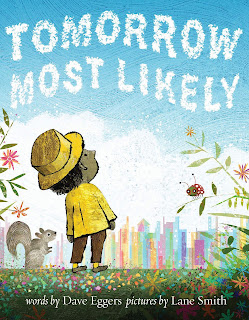
Two great children's books remind us to think positive. In Tomorrow Most Likely by Dave Eggers (Chronicle Books, 2019), a boy starts out with the assertion that "tomorrow most likely there will be a sky. And chances are it will be blue." As he goes through his day, he reassures himself of other things that are most likely tomorrow, like squirrels and airplanes, and finding rocks, but also riding whales and eating clouds. Lane Smith's amazing illustrations make this book a visual delight, and the comfort of things that are "most likely" is a perfect message to keep in mind in the coming year. 
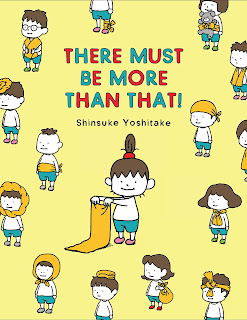
Shinsuke Yoshitake's There Must Be More Than That! (Chronicle Books, 2020) also has a great message for Elul. "Grown-ups often tell you to choose one of two things. But if neither of them seems right...there are more choices over here!" Little sister's imagination goes wild with the possibilities. From reassuring to ridiculous, we must remember there are always more than two options.

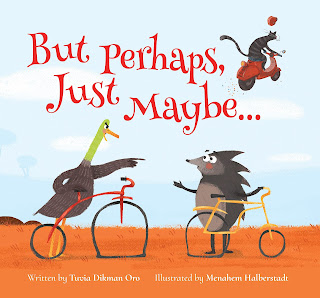
But Perhaps. Just Maybe... (Green Bean Books, 2022) was one of our favorite children's books this year. The combination of cute illustrations and mussar (character development lesson) is a winner. Bonus points that the lesson is directly from Pirke Avot -- giving the benefit of the doubt.

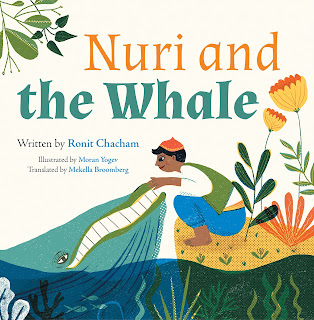
And yet another Green Bean Book based on a verse from Tanach - Nuri and the Whale. Written by Ronit Chacham, translated by Mekella Broomberg and illustrated by Oran Yogev, it tells the story of, well, Nuri and the Whale. Nuri follows his father's advice, taken from the Book of Ecclesiastes (Kohelet): "Cast your bread on the water, and one day it will come back to you" (11:1). He feeds a little fish every day, and soon the fish grows big. The fish takes him to see the Wisewhale -- the King of the Sea. Wisewhale gives Nuri the ability to understand the language of animals and gives him some parting words,"Know that there will be days to come when you will give and take -- and you will be both happy and sad." Some interesting things happen to Nuri, and he passes his sage advice to his grandchildren: "Those who open their hearts will be rewarded in the end. What will the reward be? Sometimes treasure, sometimes a smile, and sometimes a joyful heart." What a great message to start the year. The gorgeous illustrations bring the story to life.


Brene Brown's The Gifts of Imperfection (20th Anniversary Edition, Random House, 2020)is a must read, and it's a perfect book for Elul. Brown encourages everyone to strive for wholeheartedness. She provides ten guideposts to help you get there, and each guidepost has suggestions for Digging Deep -- Getting Deliberate, Getting Inspired, and Getting Going. The guideposts include cultivating self-compassion, cultivating calm and stillness, doing meaningful work (even if you are not paid in currency) and cultivating laughter, song and dance. 


The Hired Girl
by Laura Amy Schlitz, the 2016 Sydney Taylor Book Award Winner for Teen Readers, is the story of Joan/Janet, a farm girl who escapes the drudgery of her life of chores and becomes a hired girl to a Jewish family in Baltimore. There are so many wonderful aspects of this book that include Joan's honest and romantic personality, history and aspects of life in the early 1900s, and Joan's appreciation of Judaism as she works for the family. But I found this to be such an "Elul book." Joan/Janet is always inspiring -- to read more books, to learn, to become a better Catholic, and to be helpful to other people. And isn't that what Elul is all about?!

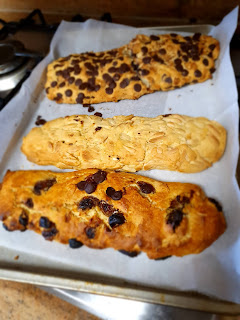
And one more time...Boulou, the sweet bread or cake that Jews of North African (Libya, Tunisia) origin traditionally eat during the month of Tishrei. (From Babka, Boulou & Blintzes: Jewish Chocolate Recipes from Around the World (Green Bean Books, 2021)


BOULOU


from Fabienne Viner-Luzzato (www.fabienneshomecooking.com)


Makes 3 boulou (each one will cut into several slices; number of slices depends on thickness)
Prep time: 30 minutes
Cook time: 15-20 minutes


Ingredients


2 large eggs (2 extra-large eggs in the US)
150 g/5 1/2 oz/3/4 cup sugar
2 teaspoons vanilla sugar
125 ml/4 fl oz/1/2 cup vegetable or sunflower oil
about 500 g/1 lb. 2 oz/ 3 3/4 cups self-raising flour (extra for dusting)
100 g/3 1/2 oz/2/3 cup dark chocolate chips
50g/ 1 3/4 oz/ 1/3 cup raisins
50 g/1 3/4 oz/1/3 cup flaked almonds


1. Preheat the oven to 200 degrees Celsius/180 degrees Celsius fan/400 degrees Fahrenheit/Gas Mark 6. Line a baking sheet with non-stick baking paper.


2. Place the eggs, both sugars and the vegetable or sunflower oil in a mixing bowl and mix together using a fork. Start adding the flour slowly, mixing with your hands to form a dough. Mix the flour in well, avoiding leaving behind lumps of flour. Add enough flour to make a soft dough -- the consistency of the dough needs to be soft, easy to touch but still slightly sticky.


3. On the work surface, divide your dough into three equal portions to make three different flavored boulou. Add the chocolate chips to one portion of dough, the raisins to another and the flaked almonds to the final portion of dough, kneading each flavoring into the dough until evenly distributed. Cook's Tip: If you prefer, you can mix all the flavoring ingredients together (the chocolate chips, raisins and almonds), then simply divide this mixture into three and knead one portion into each portion of dough.


4. Roll the flavored portions of dough into three equal-length logs (you might need to dust the work surface with a little flour first) and then flatten each one into a rectangle about 5 cm/2-inch wide and 15-20 cm/6-8-inch long, then place on the lined baking sheet.


5. Bake for 15-20 minutes, until they become golden brown. Remove from the oven and transfer to a wire rack, then leave to cool completely. Once cool, cut into 2 cm/3/4-inch thick slices to serve (or you can cut them into thinner slices, if you prefer).


6. Store the baked logs in an airtight container at room temperature for up to 4-5 days, and slice them, as needed. They will keep for longer, but will dry a little -- but they will still taste amazing dipped in hot black coffee!


As for the Real Cats of Israel, they are also excited for Elul, anticipating lots of delicious food scraps from all the cooking and baking:


Happy Reading!

Thursday, August 4, 2022

Between the Dire Straits - Bein HaMetzarim

 The three week period between the 17th of Tammuz and the 9th of Av is known as "Bein HaMetzarim" - between the dire straits, and it is the saddest period in the Jewish calendar. The custom is not to hold weddings, not to play or listen to live music, and not to cut hair or shave (as a sign of mourning). Because it is considered a time of misfortune, many avoid dangerous situations, such as travel or surgery. But, as always in Judaism, it is also a time to reflect and learn. So when we are between the "dire straits," we read a lot of Holocaust-related material:


Catherine Ehrlich writes about her grandparents' harrowing experiences in Austria before, during and after the Anschluss in Irma's Passport: One Woman, Two World Wars, and a Legacy of Courage (She Writes Press, 2021). Irma, Ehrlich's grandmother, was one of the rare women who attended university in the early 20th century. She and her first husband planned to go to England and study literature, but World War I started, and he was killed in combat. Heartbroken, Irma went to Vienna to teach. She encountered Jacob Ehrlich, whom she had known in their native Bohemia (Czech Republic). They married and had a son, Paul. Soon after, the Nazis arrived and made life miserable for the Jews. Catherine never knew her grandfather. As an active leader of the Jewish community, he was arrested and taken to Dachau, where he died. Irma was able to use her knowledge of languages and connections to escape to London with her son. She spoke to Jewish groups about the urgent need to save the Jews trapped in Nazi-occupied areas. After the World War II, she and Paul moved to the United States, where she eventually worked filing persecution claims for Holocaust survivors.

Irma literally lived history, and much of the book is about historical events. It is also interesting how many nationalist stirrings and Antisemitism there was even before World War I. Irma was a survivor, and her granddaughter combines Irma's account of her life, the historical events, and her own memories of this formidable lady to show that Irma refused to think of herself as a victim.


Subtitled "A Story of Resilience," A Child Without a Shadow (self-published, 2021) is the story of Shaul Harel. His family left Warsaw in 1932 for Brussels, where he was born Charles-David Hilsberg in 1937. When the Nazis invaded, he and his sister were separated from their parents and hidden with non-Jews. After World War II, he was sent to an orphanage, then a school, and immigrated to Israel when he was twelve. He served in the Israeli army, went to medical school, and became a renowned pediatric neurologist. This book contains a lot of reflection. Did Shaul's time as a hidden child, where his life was devoid of love, mental stimulation and fresh air, spur him to his achievements and his caring way with child patients? Another fascinating and inspiring story of someone who lived history. 


The Forgotten Memoirs
(by Esther Farbstein; Mesorah, 2011) may have the wrong title because the stories are unforgettable. Its subtitle, "Moving Personal Accounts from Rabbis Who Survived the Holocaust," gives the reader an idea of the content. Farbstein did extensive research and found that many rabbis published learned books after World War II, and in the introduction to the book or in an afterword, they described their experiences during the Holocaust. These introductions are the text of the book. Each story is unique, but there are some similarities: the rabbis' circuitous journeys through Europe to escape the Nazis, their concerns for their constituencies, and their adherence to Torah Judaism no matter the danger or challenge. It's a thick volume, but it is probably better to take breaks between each rabbi's account. 


The Vanishing
(Library Tales Publishing, 2022) by David Michael Slater is billed as "an unforgettable journey of redemption and revenge." The story starts when Sophie Siegel is eleven years old, and the situation for Jews in Germany is deteriorating quickly. As she hides from Nazis in a closet, she realizes she is invisible. Her primary goal is to keep her younger neighbor, Giddy, safe and alive. But as she moves from her village to the ghetto to a concentration camp, she learns that there are no rules, and no justice. Full of action and full of graphic detail of Nazi atrocities, the reader will root for Sophie and Giddy. 


Hopefully, this will be the last time we read Holocaust books during the Three Weeks because they will be transformed into days of joy!

As for the Real Cats of Israel, we've had quite a parade of feral cats, including Noga:


Meaningful reading!